Does a Boom Lift Operator Need to Be Certified in 2026?
Quick Answer

Get OSHA-Compliant Boom Lift
Certification in About an Hour
★ Key Takeaways
- Boom lifts are governed by 29 CFR 1926.453, a separate OSHA standard from scissor lifts, which are classified as scaffolds. Different equipment, different rules.
- Tie-off is mandatory at all times when working from a boom lift basket. This is not situational like scissor lifts; it is a hard OSHA requirement.
- Tying off to adjacent poles, structures, or equipment from a boom lift is explicitly prohibited under 29 CFR 1926.453(b)(2)(iii). The lanyard must connect to the boom or basket.
- OSHA does not certify operators or approve training courses. The employer certifies each operator after training and an in-person evaluation by a qualified person.
- Boom lift certification expires after three years. Refresher training is required after incidents, near-misses, unsafe behavior, or changes in equipment.
- Lift controls must be tested daily before use. Moving an elevated boom lift with workers in the basket is prohibited unless the equipment is specifically designed for it.
- VITAL: State-level OSHA plans, including California, Washington, and others, may impose stricter requirements than federal OSHA minimums.
“Failure to train is the #1 cause of boom lift accidents.”
According to a top personal injury law firm, the failure to properly train and certify employees is the
number one cause of aerial and boom lift accidents. A lack of safety gear and the improper use of safety
gear are the top causes of aerial lift fatalities.
Source: patrickdaniellaw.com
What Is a Boom Lift and How Does OSHA Classify It?
A boom lift is a type of Mobile Elevating Work Platform (MEWP) that uses a hydraulic arm,
either telescoping, articulating, or a combination of both, to position workers at elevated heights.
Unlike scissor lifts, which raise a platform straight up on a scissor mechanism, boom lifts can reach
out and around obstacles, making them the preferred tool for construction, maintenance, and utility work.
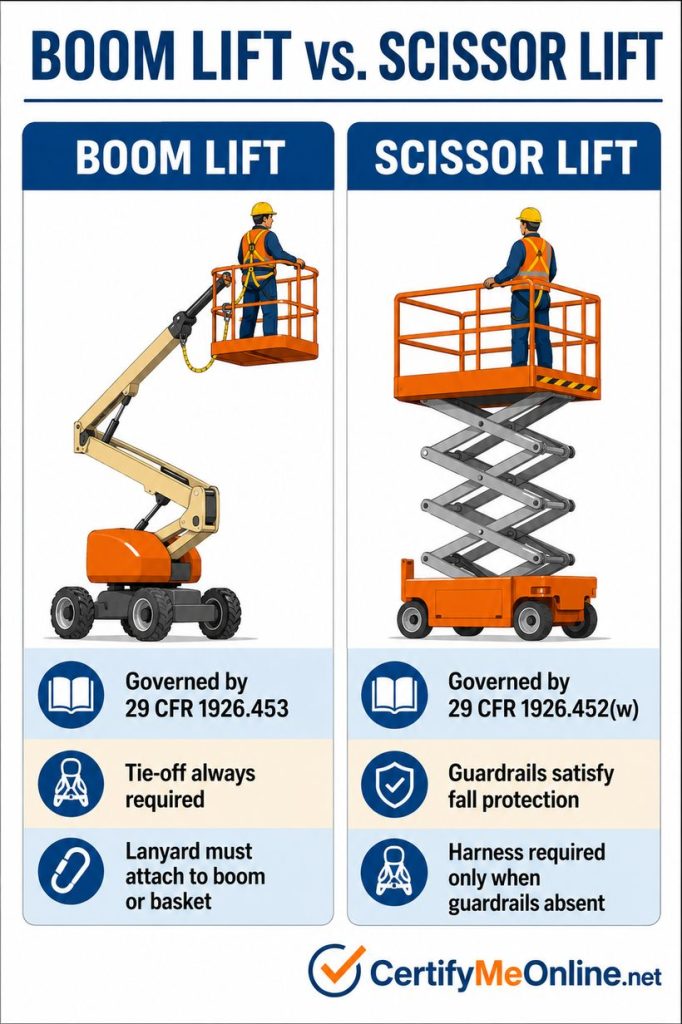
OSHA classifies boom lifts as aerial lifts under 29 CFR 1926.453. This is a critical distinction.
Scissor lifts are classified as mobile scaffolds and governed by 29 CFR 1926.452(w). The two standards
have fundamentally different fall protection requirements.
Under the scaffold standard, guardrails can serve as adequate fall protection for scissor lift
operators. Under the aerial lift standard, boom lift operators must always be tied off; guardrails
alone are not sufficient.
OSHA’s aerial lift standard (29 CFR 1926.453) covers the following equipment types:
- Extensible boom platforms (telescopic booms)
- Articulating boom platforms (knuckle booms)
- Aerial ladders
- Vertical towers
- Any combination of the above
Source: 29 CFR 1926.453(a)(1) — osha.gov/laws-regs/regulations/standardnumber/1926/1926.453
Get OSHA-Compliant in About an Hour
— Enroll Now for $75
OSHA and ANSI Standards That Govern Boom Lift Certification
| Standard | What It Covers |
|---|---|
| 29 CFR 1926.453 | The primary OSHA standard governing boom lifts. Covers extensible boom platforms, aerial ladders, articulating boom platforms, and vertical towers. Requires tie-off at all times when working from the basket. |
| 29 CFR 1926.453(b)(2)(v) | Employees must wear a body belt and attach a lanyard to the boom or basket when working from an aerial lift. Body belts used as fall restraint (tethering) remain acceptable under 1926.502(e). |
| 29 CFR 1926.454 | Training requirements for aerial lift operators. Employers must train workers by a qualified person before operation. Covers hazard recognition, safe operation, and emergency procedures. |
| 29 CFR 1926.502(d) | Personal fall arrest system (PFAS) requirements. The anchor must support 5,000 lbs per attached worker. Free fall is limited to 6 feet or less. Full-body harness required for fall arrest systems. |
| 29 CFR 1910.67 | General industry standard for vehicle-mounted elevating and rotating work platforms. Applies when boom lifts are used in general industry settings, not in construction |
| ANSI A92.2-1969 | Design and construction standards are incorporated by reference into 29 CFR 1926.453. Boom lifts must be designed and constructed in conformance with this standard. |
| ANSI A92.22 / A92.24 | Updated training and safe-use standards for Mobile Elevating Work Platforms (MEWPs). Covers operator qualifications, pre-use inspection, and equipment design requirements. |
OSHA Boom Lift Certification Requirements
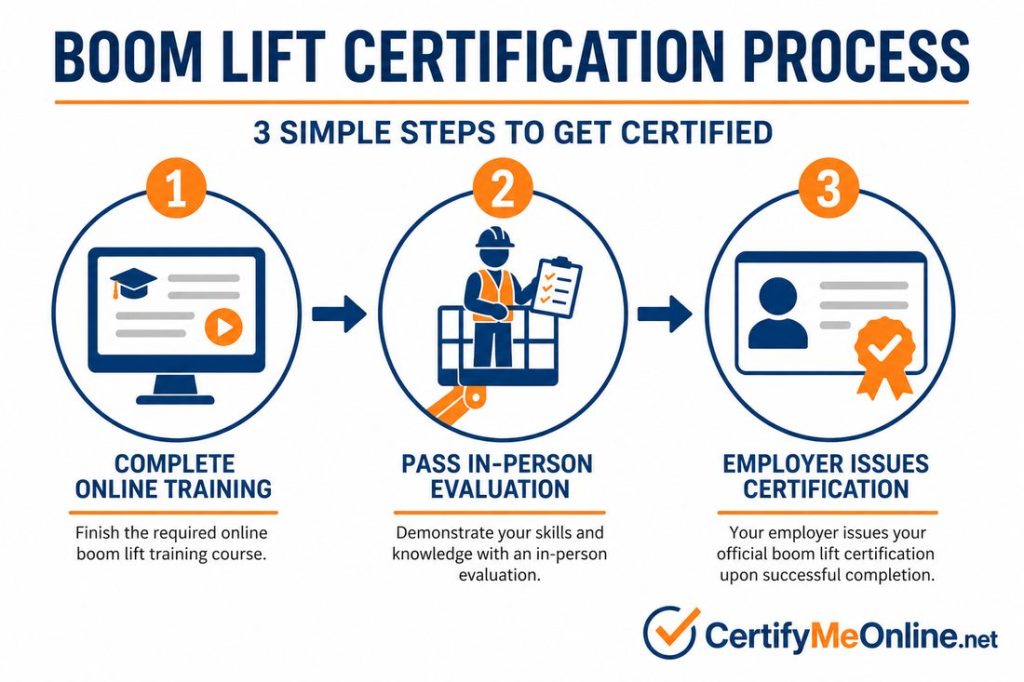
1. Formal Training by a Qualified Person
- Training must be conducted by a person qualified to recognize the hazards associated with the specific type of aerial lift in use.
- Training must cover safe operation of the equipment, hazard identification, fall protection requirements, load capacity limits, and emergency procedures.
- Training must include manufacturer-specific guidelines for the model being operated.
- CertifyMeOnline.net’s online course satisfies the formal training component and can be completed in about an hour on any internet-connected device.
2. Hands-On Practical Evaluation
- After completing the educational component, the operator must undergo an in-person evaluation by a certified trainer or qualified employer representative.
- The evaluator must assess the operator’s ability to safely handle the equipment in a real operating environment.
- This evaluation cannot be completed online; it must occur on-site with the actual equipment.
- Employers who need an in-house evaluator can complete CertifyMeOnline.net’s Train-the-Trainer program, which certifies an employee to conduct and document operator evaluations for the entire team.
3. Employer Certification and Documentation
- Upon passing both the training and evaluation, the employer certifies the operator and issues documentation.
- Certification records must be maintained and made available during OSHA inspections. Missing documentation is among the most common citation triggers.
- Records must identify the operator, the trainer or evaluator, the date of training and evaluation, and the type of equipment covered.
4. Refresher Training Triggers
- Operators demonstrate unsafe behavior on the job.
- A workplace incident or near-miss involving a boom lift occurs.
- An operator receives an unsatisfactory evaluation result.
- The operator is assigned to a different type of boom lift or aerial equipment.
- Changes in workplace conditions create new hazards not covered in the original training.
Train Your Team in About an Hour
— Get Started Today
Benefits of Certification vs. Risks of Skipping It
| Benefits of Boom Lift Certification | Risks of Operating Without Certification |
|---|---|
| Full OSHA compliance — no citation exposure | OSHA citations start at several thousand dollars per violation |
| Operators understand mandatory tie-off requirements specific to boom lifts | Willful violations up to $156,259 per citation (2024 penalty schedule) |
| Reduced risk of tip-over, falls, and electrocution incidents | Elevated civil liability if an incident occurs involving an uncertified operator |
| Lower workers’ comp and liability insurance exposure | Higher accident rates, untrained operators are the leading cause of boom lift fatalities |
| Documentation on file for OSHA inspections | Project shutdowns and production delays during OSHA investigations |
| Operators know how to conduct required daily pre-use inspections | Reputational damage with clients and general contractors |
Mandatory Safety Requirements for Boom Lift Operation
Tie-Off Is Always Required
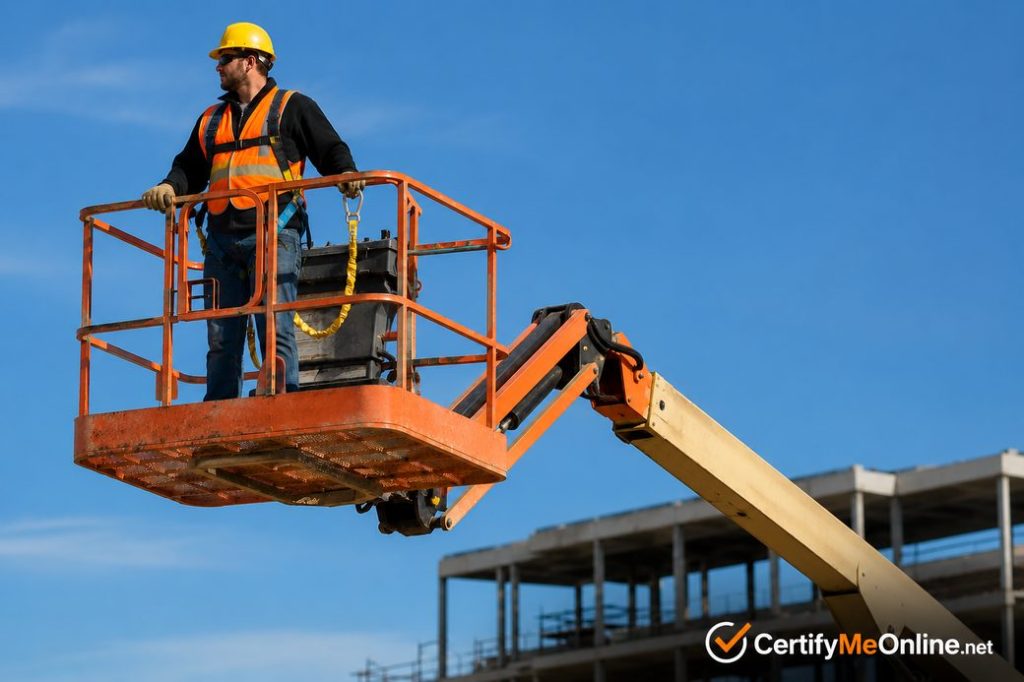
This is the most significant difference between boom lifts and scissor lifts. Under 29 CFR 1926.453(b)(2)(v), a body belt or full-body harness must be worn, and a lanyard must be attached to the boom or basket at all times when working from an aerial lift. There is no guardrail exception for boom lifts.
Note: As of January 1, 1998, body belts are not acceptable as part of a personal fall arrest system under 29 CFR 1926.502(d). Body belts remain acceptable for tethering and fall restraint use under 29 CFR 1926.502(e). A full-body harness is required when using a PFAS.Tying Off to Adjacent Structures Is Prohibited
Under 29 CFR 1926.453(b)(2)(iii), tying off to an adjacent pole, structure, or equipment while working from an aerial lift is explicitly prohibited. The lanyard must be attached to the boom or basket, not to a nearby building, pole, beam, or other structure. This is the opposite of the general construction Subpart M approach and is one of the most commonly misunderstood requirements for boom lift operators.Daily Pre-Use Inspection
- Lift controls must be tested each day prior to use under 29 CFR 1926.453(b)(2)(i).
- This includes testing upper and lower controls, emergency functions, brakes, and
outrigger systems. - Deficiencies must be corrected before the lift is used, not noted and deferred.
No Elevated Travel Unless Designed for It
- An aerial lift truck must not be moved when the boom is elevated with workers in the
basket, unless the equipment is specifically designed for this operation per 29 CFR
1926.453(b)(2)(viii). - Before moving for highway travel, the boom must be properly cradled and outriggers
stowed per 29 CFR 1926.453(b)(2)(xii).
Platform Conduct Requirements
- Employees must always stand firmly on the basket floor. Sitting or climbing on the edge of the basket is prohibited under 29 CFR 1926.453(b)(2)(iv).
- Planks, ladders, or other devices used as a work position within the basket are prohibited.
- Climbers (lineman’s climbing spurs) may not be worn while performing work from an aerial lift per 29 CFR 1926.453(b)(2)(x).
- Manufacturer boom and basket load limits must never be exceeded per 29 CFR 1926.453(b)(2)(vi).
Worksite and Stability Requirements
- Brakes must be set before operation. When outriggers are used, they must be positioned on pads or a solid surface per 29 CFR 1926.453(b)(2)(vii).
- Wheel chocks must be installed before using a boom lift on an incline when they can be safely installed.
- Employers must assess worksite conditions before operations begin, including ground load capacity, overhead obstructions, slope, and proximity to energized power lines.
Learning How to React in a Boom Lift Emergency Can Save Your Life
Falls are the leading cause of death in the construction industry, and boom lifts pose a unique set of hazards that differ significantly from those of ground-level work. The height and reach of a boom lift means that a fall, tip-over, or ejection incident is unlikely to be survivable without proper fall protection, properly rigged and used by an operator who actually understands how it works.
Certification is not just a compliance checkbox. It is the difference between an operator who reacts correctly when something goes wrong and one who doesn’t.
Common operator errors that turn survivable situations fatal:
- Tying off to an adjacent structure rather than to the boom or basket is explicitly prohibited and creates a false sense of security.
- Not being tied off at all is the most common cause of fatal boom lift falls.
- Exceeding the basket load limit shifts the center of gravity and increases the risk of tipping over.
- Moving the lift while elevated without verifying the equipment is rated for elevated travel.
- Standing on the guardrail or using improvised work platforms inside the basket.
- Failing to conduct the required daily pre-use inspection; defects discovered mid-operation cannot be safely addressed at height.
- Positioning the lift near energized power lines without observing minimum approach distances.
CertifyMeOnline.net’s boom lift and aerial lift certification training covers all of these scenarios. Knowing what the equipment can and cannot do, and what OSHA requires in every operating situation, is what separates a trained operator from one who is simply hoping nothing goes wrong.
Get Certified — $75, About an Hour, Instant Digital Card
Why Invest in Boom Lift Certification Training
Certification is not just a legal requirement. It is the most cost-effective investment in workforce safety an employer can make. The math is straightforward: a boom lift certification costs $75 per operator and takes about an hour. A single OSHA citation for an uncertified operator starts at several thousand dollars. A serious incident involving an uncertified operator can result in civil liability that dwarfs both numbers.
CertifyMeOnline.net provides comprehensive boom lift and aerial lift certification that meets all OSHA requirements for the training component. Our courses teach operators:
- OSHA’s specific requirements for boom lift operation, including mandatory tie-off and the prohibition on tying off to adjacent structures.
- How to conduct required daily pre-use inspections and what to look for.
- Load capacity, stability principles, and the physics of tip-over risk.
- Proper fall protection selection and use for aerial lift operations.
- Emergency and rescue procedures specific to elevated work platforms.
- Manufacturer-specific operating procedures and restrictions.
Common Misconceptions About Boom Lift Certification
Misconception 1: Boom Lifts and Scissor Lifts Have the Same OSHA Requirements
They do not. Scissor lifts are classified as mobile scaffolds under 29 CFR 1926.452(w). Boom lifts are aerial lifts under 29 CFR 1926.453. The fall protection rules are fundamentally different. Scissor lift operators can rely on guardrails as fall protection. Boom lift operators must be tied off at all times, no exceptions.Misconception 2: OSHA Certifies Operators
OSHA does not certify lift operators or approve specific training courses or providers. What OSHA requires is a training and evaluation process that the employer conducts, documents, and certifies. When you complete training through CertifyMeOnline.net, the training component is satisfied. The employer-conducted in-person evaluation completes the process, and the employer issues the certification.Misconception 3: You Can Tie Off to a Nearby Structure
Explicitly false for boom lifts. 29 CFR 1926.453(b)(2)(iii) prohibits tying off to adjacent poles, structures, or equipment while working from an aerial lift. The lanyard must attach to the boom or basket. This is a frequently cited violation and a genuine safety hazard; a structural failure of the anchor point at height is not recoverable.Misconception 4: Certification Lasts Indefinitely
Boom lift certification is valid for three years. After that, operators must complete the renewal process. Additionally, refresher training is required before the three-year mark if an operator demonstrates unsafe behavior, is involved in an incident or near-miss, receives an unsatisfactory evaluation, or is assigned to a different type of equipment. CertifyMeOnline.net provides free lifetime renewal for all certifications issued through our platform.Misconception 5: Brief or Occasional Use Doesn’t Require Certification
There is no OSHA exception for short-duration or infrequent boom lift operation. The certification requirement applies every time a worker operates the equipment, regardless of duration, frequency, or prior experience with similar equipment. An employer who allows an uncertified operator to use a boom lift, even for five minutes, is subject to a citation and, in the event of an incident, faces significantly elevated liability.Get OSHA-Compliant Boom Lift Certification in About an Hour
FAQs: Boom Lift Certification Requirements
These questions come directly from operators, safety managers, and employers. If yours isn’t
here, call us at (602) 277-0615; we answer the phone.
Does a boom lift operator need to be certified?
Yes. OSHA requires all boom lift operators to be trained and certified before operating the
equipment under 29 CFR 1926.454. The employer administers the training and evaluation
process and issues the certification. There are no exceptions for brief use, experienced
operators, or temporary workers.
Do you need a license to operate a boom lift?
In the US, OSHA does not issue operator licenses or certificates. The requirement is an
employer-issued certification following a training and in-person evaluation process. Some states
with their own OSHA plans may have additional requirements; always verify local regulations.
Outside the US, licensing requirements vary significantly by country and jurisdiction.
What is the OSHA standard for boom lift certification?
The primary standards are 29 CFR 1926.453 (aerial lift safety requirements), 29 CFR 1926.454
(training requirements), and 29 CFR 1926.502(d) (personal fall arrest system requirements
when a PFAS is used). For general industry settings, 29 CFR 1910.67 applies. Boom lifts must
also conform to ANSI A92.2-1969 for design and construction.
Do boom lift operators always have to be tied off?
- Yes. Under 29 CFR 1926.453(b)(2)(v), a body belt or full-body harness must be worn and a
lanyard attached to the boom or basket at all times when working from a boom lift. This is not
situational; it applies regardless of height, duration, or the presence of guardrails. This is the
primary difference between the fall protection requirements for boom lifts and scissor lifts
Can I tie my lanyard to a building or pole while working from a boom lift?
No. 29 CFR 1926.453(b)(2)(iii) explicitly prohibits tying off to adjacent poles, structures, or
equipment while working from an aerial lift. The lanyard must attach to the boom or basket. This
is one of the most commonly cited boom lift violations, and one of the most dangerous, because
an adjacent anchor point failure at height leaves the operator with no protection.
What is the difference between a boom lift and a scissor lift?
A scissor lift raises a platform straight up on a scissor mechanism and is classified as a mobile
scaffold under OSHA. A boom lift uses a hydraulic arm to position workers at height and can
reach out and around obstacles. Boom lifts are classified as aerial lifts. The critical regulatory
difference: scissor lift operators can rely on guardrails for fall protection; boom lift operators
must be tied off at all times.
What is the difference between a boom lift and an aerial lift?
A boom lift is one type of aerial lift. OSHA’s aerial lift standard (29 CFR 1926.453) covers
extensible boom platforms, articulating boom platforms, aerial ladders, vertical towers, and
combinations of these. All boom lifts are aerial lifts, but not all aerial lifts are boom lifts. Scissor
lifts are NOT classified as aerial lifts under OSHA’s standard.
How long does a boom lift certification last?
Boom lift certification is valid for three years. After that, the operator must complete the renewal
process, which may skip the educational component if the operator demonstrates competency
through evaluation. Refresher training is also required before the three-year mark when specific
triggers occur, such as unsafe behavior, incidents, near-misses, unsatisfactory evaluations, or
equipment changes. CertifyMeOnline.net provides free lifetime renewal for all certifications.
What does boom lift certification training cover?
OSHA requires training to cover hazard recognition, safe operation of the specific equipment,
fall protection requirements, load capacity and stability, pre-use inspection procedures, and
emergency procedures. CertifyMeOnline.net’s course covers all of these topics plus the
mandatory tie-off requirements and prohibited practices specific to boom lifts, information that is
frequently missing from generic aerial lift courses.
Can a boom lift certification be done online?
The educational training component can be completed online. CertifyMeOnline.net’s course
takes about an hour and can be accessed on any internet-connected device. However, OSHA
requires an in-person evaluation by a qualified person as part of the certification process. The
employer or a designated in-house evaluator (certified through our Train-the-Trainer program)
must conduct this evaluation with the operator on the actual equipment.
What happens if OSHA finds an uncertified boom lift operator?
OSHA can issue citations and fines for uncertified boom lift operators. Serious violations start at
several thousand dollars per citation. Willful violations, where the employer knew of the
requirement and ignored it, can carry a penalty of $156,259 per citation under the 2024 penalty
schedule. If an incident involving an uncertified operator occurs, civil liability exposure increases
substantially. The $75 cost of certification is not a meaningful comparison to the potential
consequences.
Does my boom lift certification transfer between employers?
OSHA does not issue transferable certifications. Each employer is responsible for verifying
operator competency for the specific equipment in use at their worksite. A new employer may
accept prior training documentation, but is still responsible for conducting their own evaluation to
verify the operator’s ability to safely handle the specific equipment and site conditions. When in
doubt, retraining is the safer and lower-risk choice.
What are the pre-use inspection requirements for boom lifts?
Under 29 CFR 1926.453(b)(2)(i), lift controls must be tested each day prior to use to verify safe
working conditions. The daily inspection should cover upper and lower controls, emergency
lowering functions, brakes, outrigger systems, hydraulic fluid levels, structural integrity of the
boom and basket, and any visible damage. Deficiencies must be corrected before the lift is
used. Documentation of inspections creates a paper trail that protects employers during OSHA
investigations.
Are boom lift requirements different for indoor vs. outdoor use?
The core OSHA requirements under 29 CFR 1926.453 apply regardless of indoor or outdoor
use. However, outdoor conditions introduce additional hazards that must be addressed: wind
(most boom lifts have maximum wind speed ratings, typically 28-40 mph depending on
configuration), uneven or soft ground affecting stability, proximity to overhead power lines, and
traffic control. Employers must assess site-specific conditions before each operation.
What is the Train-the-Trainer program, and do I need it?
The Train-the-Trainer program certifies one of your employees to conduct the in-person
evaluation component of boom lift certification for other operators at your facility. If you have
multiple operators or expect to hire new ones regularly, having a certified in-house trainer
eliminates the need to bring in outside evaluators every time. CertifyMeOnline.net’s
Train-the-Trainer certification is valid for three years and covers all MEWP types, including
boom lifts, scissor lifts, and other aerial platforms.
How often does OSHA update its boom lift requirements?
OSHA updates its core standards infrequently; major revisions happen every few years in
response to new data, technology changes, court decisions, or significant industry incidents.
The aerial lift standard (29 CFR 1926.453) has been relatively stable, though ANSI standards
for MEWPs have been updated more recently (A92.22 and A92.24). Subscribe to OSHA
QuickTakes at osha.gov/quicktakes to stay current. State-level OSHA plans update
independently and may change on different timelines.
Ready to Certify Your Team? Start Now for $75
Claims Made — OSHA Fact Check
Every claim on this page is traceable to an OSHA standard or official interpretation letter. The table below documents the primary claims and their sources.
| Claim Made | OSHA Source |
|---|---|
| Boom lifts are governed by 29 CFR 1926.453, not the scaffold standard | 29 CFR 1926.453(a)(1) — osha.gov/laws-regs/regulations/standardnum ber/1926/1926.453 |
| Workers must always be tied off when working from a boom lift basket | 29 CFR 1926.453(b) (2)(v) — body belt and lanyard required at all times |
| Tying off to an adjacent pole or structure is prohibited on boom lifts | 29 CFR 1926.453(b)(2)(iii) — osha.gov/laws-regs/regulations/standardnum ber/1926/1926.453 |
| OSHA does not certify operators — employer certification is required | 29 CFR 1926.454 — training and employer evaluation required; OSHA does not issue operator certificates |
| Boom lifts must not be moved when elevated with workers in the basket unless specifically designed for it | 29 CFR 1926.453(b)(2)(viii) |
References
- OSHA 29 CFR 1926.453 — Aerial Lifts (Boom Lifts): osha.gov/laws-regs/regulations/standardnumber/1926/1926.453
- OSHA 29 CFR 1926.454 — Training Requirements for Scaffold and Aerial Lift Workers: osha.gov/laws-regs/regulations/standardnumber/1926/1926.454
- OSHA 29 CFR 1910.67 — Vehicle-Mounted Elevating and Rotating Work Platforms: osha.gov/laws-regs/regulations/standardnumber/1910/1910.67
- OSHA Aerial Lifts Fact Sheet: osha.gov/sites/default/files/publications/aerial-lifts-factsheet.pdf
- OSHA eTool — Aerial Lifts: osha.gov/etools/scaffolding/aerial-lifts
- ANSI A92.22 / A92.24 — MEWP Training and Safe-Use Standards