Does OSHA Require a Harness on a Scissor Lift in 2026?
Quick Answer
★ Key Takeaways
- Scissor lifts are classified as mobile scaffolds under OSHA, not aerial lifts. This distinction determines which fall protection rules apply.
- Guardrails alone are sufficient fall protection when they are intact and meet OSHA standards. A harness is not required in that scenario.
- Fall protection is required when workers are 10 feet or more above a lower level — the scaffold standard threshold, not the 6-foot general construction rule.
- A harness is mandatory when guardrails are absent, damaged, or removed, or when the employer, equipment manufacturer, or local jurisdiction requires one.
- Personal fall arrest systems (PFAS) must meet 29 CFR 1926.502(d): anchor rated for 5,000 lbs. per worker, full-body harness, and a connecting device that limits free fall to 6 feet or less.
- VITAL: Always check state-level OSHA plans and employer policies, they may impose stricter requirements than federal OSHA minimums.

OSHA Classification: Why Scissor Lifts Follow Scaffold Rules
There is widespread confusion about which OSHA standards apply to scissor lifts. Many operators and employers assume they fall under the aerial lift standard. They do not.
OSHA’s aerial lift provisions (29 CFR 1926.453) apply only to equipment defined in the ANSI A92.2-1969 standard as aerial lifts. That definition covers extensible boom platforms, aerial ladders, articulating boom platforms, and vertical towers. Scissor lifts are not included.
Because scissor lifts raise workers on a platform, they meet OSHA’s definition of a scaffold. The applicable standards are:
- 29 CFR 1926.451 — General requirements for all scaffolds
- 29 CFR 1926.452(w) — Additional requirements specific to mobile scaffolds
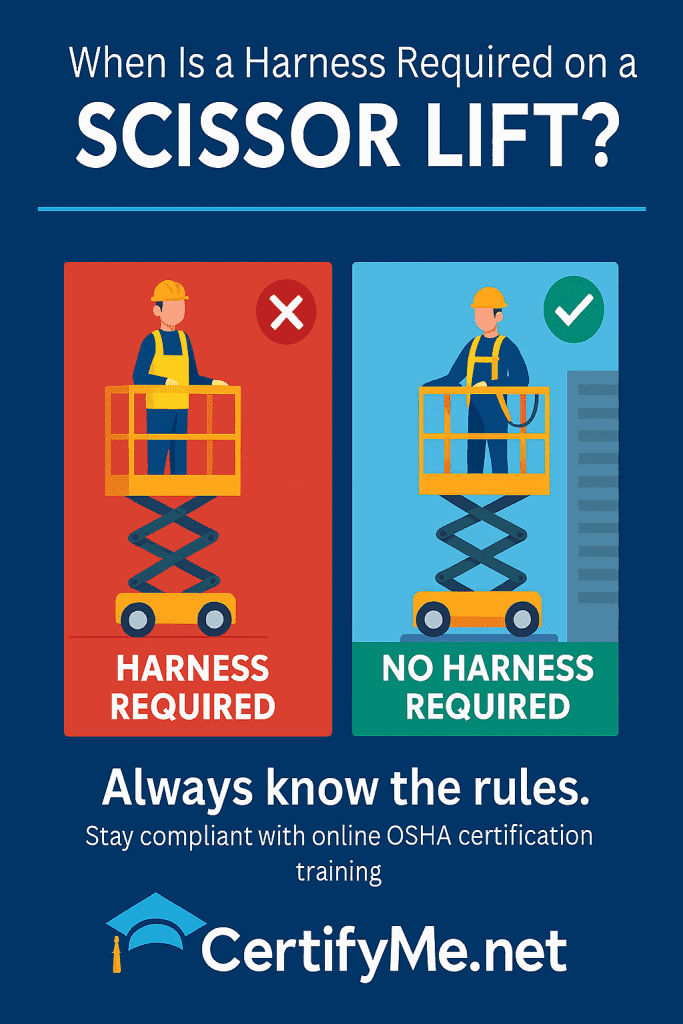
This classification matters because the two standards have different fall protection requirements. Under the aerial lift standard, workers must always be tied off. Under the scaffold standard, guardrails satisfy the fall protection requirement when properly installed and maintained.
Source: OSHA Standard Interpretation, August 1, 2000 — osha.gov/laws-regs/standardinterpretations/2000-08-01-0
OSHA and ANSI Standards That Apply to Scissor Lift Harness Requirements
| Standard | What It Covers |
|---|---|
| 29 CFR 1926.451(g) | Scaffold fall protection: workers elevated 10 feet or more above a lower level must be protected by guardrails or a personal fall arrest system. This is the primary standard governing fall protection for scissor lifts. |
| 29 CFR 1926.452(w) | Additional requirements for mobile scaffolds, the specific category scissor lifts fall under. Governs stability, movement, and fall protection. |
| 29 CFR 1926.454 | Training requirements for aerial lift operators. Employers must train workers by a qualified person before operation. Covers hazard recognition, safe operation, and emergency procedures. |
| 29 CFR 1926.502(d) | Personal fall arrest system (PFAS) requirements. The anchor must support 5,000 lbs. per attached worker. The system must limit free fall to 6 feet or less. Full-body harness required; body belts alone do not qualify. |
| ANSI A92.6-2006 | Design and performance standard for self-propelled elevating work platforms. OSHA recognizes compliance with this standard as providing adequate fall protection when compliant guardrails are in place. |
| ANSI A92.22 / A92.24 | Updated training and safe-use standards for Mobile Elevating Work Platforms (MEWPs). Covers operator qualifications, pre-use inspection, and equipment design requirements. |
When Is a Harness Required on a Scissor Lift?
The guardrail exemption has limits. A harness or personal fall restraint system is required in the following situations:
Guardrails Are Absent, Damaged, or Removed
- If the guardrail system does not meet OSHA standards, fall protection reverts to a personal fall arrest or restraint system.
- This includes platforms where guardrails have been partially removed to allow access to a work area.
- Damaged rails that have not been formally tagged out and repaired carry the same obligation.
The Worker Leaves the Platform
- When an operator exits the elevated platform to access a structure, for example, the scaffold fall protection rules no longer apply. General fall protection under 29 CFR 1926.501(b)(1) requires protection at 6 feet above a lower level.
- A harness anchored to an approved anchor point is required in this scenario.
- Returning to the platform from an elevated surface carries the same requirement until the worker is safely back within the guardrail system.
The Employer or Manufacturer Requires One
- Employer safety programs frequently require harnesses regardless of OSHA’s minimum standard.
- Some manufacturers specify harness use in their operator manuals. When they do, it becomes part of the safe operating procedure.
- When an employer’s written safety policy requires harnesses in scissor lifts, that policy becomes OSHA-enforceable under the General Duty Clause, even when federal minimums don’t require one.
Local or State Regulations Require One
- States with their own OSHA-approved plans, such as California, Michigan, Washington, and others, may impose stricter requirements than federal OSHA.
- Always verify local requirements before assuming federal minimums apply.
A Note on Tying Off to Adjacent Structures
Operators sometimes ask whether they can tie off to a nearby pole, wall, or structure rather than to the scissor lift itself. The scaffold standard does not specifically address this. OSHA’s General Duty Clause prohibits the practice only when the industry recognizes it as hazardous, and an alternative means of protection is available. When a manufacturer-approved anchor point is present on the platform, it is the preferred tie-off location.
There is widespread confusion about which OSHA standards apply to scissor lifts. Many operators and employers assume they fall under the aerial lift standard. They do not.
OSHA’s aerial lift provisions (29 CFR 1926.453) apply only to equipment defined in the ANSI A92.2-1969 standard as aerial lifts. That definition covers extensible boom platforms, aerial ladders, articulating boom platforms, and vertical towers. Scissor lifts are not included.
Because scissor lifts raise workers on a platform, they meet OSHA’s definition of a scaffold. The applicable standards are:
- 29 CFR 1926.451 — General requirements for all scaffolds
- 29 CFR 1926.452(w) — Additional requirements specific to mobile scaffolds
This classification matters because the two standards have different fall protection requirements. Under the aerial lift standard, workers must always be tied off. Under the scaffold standard, guardrails satisfy the fall protection requirement when properly installed and maintained.

Pros and Cons of Wearing a Harness on a Scissor Lift
| ✓ Pros of Wearing a Harness | ⚠ Cons / Limitations to Consider |
|---|---|
| Backup protection if guardrails fail or are compromised | Can restrict range of motion on the platform |
| Required by many employer safety programs and insurance carriers | May create a false sense of security if improperly anchored |
| Protects workers who lean beyond the platform edge or exit at height | Requires a manufacturer-approved anchor point on the platform |
| Reduces employer liability exposure in the event of an OSHA inspection or incident | Not a substitute for a properly maintained guardrail system |
| Provides added protection when working outdoors in high wind or on uneven terrain | An improperly rigged harness can cause tip-over if the worker goes over the rail |
Types of Fall Protection Systems for Scissor Lifts
When a harness is required or elected, the right system matters. OSHA recognizes three acceptable approaches for fall protection on elevated work platforms:
Fall Restraint System (Preferred for Scissor Lifts)
- A body belt or full-body harness connected to an anchor point with a lanyard short enough to prevent the worker from reaching a fall hazard.
- The preferred system for scissor lifts: it prevents the fall from occurring rather than arresting it after the fact.
- Anchor must be rated for the applicable loads per ANSI/SIA requirements.
- Lanyard length must be set so the worker physically cannot reach the platform edge or guardrail opening.
Personal Fall Arrest System (PFAS)
- Designed to stop a fall after it begins. Consists of three components: a full-body harness, a connecting device (shock-absorbing lanyard or self-retracting lifeline), and a rated anchor point.
- The anchor point must support at least 5,000 lbs per attached worker (29 CFR 1926.502(d)).
- The system must limit free fall to 6 feet or less and prevent contact with a lower level.
- Body belts alone do not constitute a PFAS. A full-body harness is required.
- Note: On many scissor lifts, insufficient clearance between the platform and lower structures makes a full PFAS impractical. A restraint system is often the only appropriate option.
⚠ Important: Positioning Devices Do Not Apply to Scissor Lifts
Some fall protection discussions reference positioning devices as an option on elevated work platforms. OSHA is explicit on this point: positioning devices are designed for use on vertical work surfaces. Workers on scissor lifts are on a horizontal platform. Positioning devices may not be used as fall protection in this context.
Learning How to React to a Fall Can Save Your Life
Falls are the leading cause of death in the construction industry.
Understanding how to react when a fall begins, and how fall protection
equipment actually works, is not just regulatory knowledge.
It is survival knowledge.
A scissor lift harness does not stop you from falling off an elevated platform.
What it does is catch you when you do, and the difference between a survivable
fall and a fatal one often comes down to whether the system was properly rigged,
inspected, and understood before the operator ever left the ground.
Harnesses also help workers stay upright during a fall, which allows a deceleration
device to deploy correctly. The device keeps the spine vertical so it can absorb
the force of arrest rather than concentrating it on the torso. These are not abstract
concepts, they are the mechanical reasons why training matters as much as the
equipment itself.
Common operator errors that turn a survivable situation fatal:
- Connecting a lanyard to a guardrail rather than a rated anchor point.
The guardrail fails under the dynamic load. - Using an improperly sized or uninspected harness, webbing damage or
buckle failure during arrest. - Exceeding lanyard length, insufficient clearance below the platform
means contact with a lower level before arrest is complete. - Tying off while elevated and then driving the lift, creating a tip-over
risk from the tensioned connection. - Failing to inspect equipment before use, worn webbing, or corroded
hardware that fails at the moment of load.
CertifyMeOnline.net’s fall protection training covers all of these scenarios.
Knowing how to react, what your equipment actually does, and where the failure
points are is the difference between walking away and not.
Employer Responsibilities Under OSHA
Regardless of whether a harness is required on a given job site, employers carry specific obligations for every scissor lift operation.
Training and Certification
- All scissor lift operators must be trained and certified before operating the equipment. This is not optional.
- Training must cover proper operation, hazard recognition, fall protection procedures, and manufacturer-specific guidelines for the equipment in use.
- Operator competency must be verified through evaluation, not just completion of a course.
- Documentation of training must be maintained and available for OSHA inspection.
- Refresher training is required when operators demonstrate unsafe behavior, new equipment is introduced, or an incident occurs.
Equipment Maintenance
- Scissor lifts must be maintained per manufacturer’s specifications.
- Pre-use inspections are required before each shift. Deficiencies must be addressed before the lift is used.
- Guardrail systems must be intact, properly installed, and meet OSHA height and strength requirements.
Worksite Assessment
- Employers must assess the worksite before operations begin to identify overhead hazards, ground conditions, slope, and proximity to energized power lines.
- Scissor lifts rated for outdoor use are generally limited to wind speeds below 28 mph.
- Traffic control measures must be in place when lifts operate near pedestrians or vehicles.
Why Invest in Scissor Lift Fall Protection Training
Safety harnesses are only one component of a quality safety program. The equipment is only as effective as the operator’s understanding of when and how to use it. That understanding comes from training, and the cost of not having it is measured in OSHA citations, workers’ compensation claims, legal liability, and, in the worst cases, lives.
CertifyMeOnline.net offers comprehensive scissor lift fall protection training that pairs directly with the equipment and safety policies on your job site. Our training teaches workers:
- When fall protection devices are legally required and when they are optional but recommended.
- The correct use of fall restraint systems, personal fall arrest systems, and their components.
- How to inspect harnesses, lanyards, and anchor points before every use.
- OSHA’s specific requirements for scissor lift operators, including documentation and evaluation requirements.
- How to recognize and respond to worksite hazards before they become incidents.
Our courses are 100% OSHA-compliant, fully online, and available on any device at any time. No books to buy, no classroom to attend. In about an hour, your operator, or your entire team, can earn documented, verifiable certification with a digital card issued immediately upon completion.
We also offer a Train-the-Trainer program for employers who want a certified in-house trainer on staff, someone who can conduct and document operator evaluations without relying on outside vendors every time new equipment is introduced or a refresher is required.
The investment in training is minimal. The cost of skipping it is not.
Common Misconceptions About Scissor Lift Harness Requirements
Myth #1
Guardrails Always Eliminate the Need for a Harness
Guardrails satisfy OSHA’s fall protection requirement when they are intact and compliant. But if an operator leans over the guardrail, exits the platform, or the guardrail is compromised in any way, the exemption no longer applies. The guardrail is not a substitute for understanding when a harness is required.
Myth #2
The 6-Foot Rule Applies to Scissor Lifts
OSHA’s 6-foot fall-protection trigger applies to general construction activities under Subpart M. Scissor lifts are governed by the scaffold standard, which sets the fall-protection threshold at 10 feet above a lower level. Using the 6-foot number in scissor lift harness discussions is technically incorrect and is a common error found on competitor sites.
Myth #3
Any Harness Will Do
When a harness is required, it must be appropriate for the application. Fall restraint systems are typically preferred on scissor lifts. If a PFAS is used, it must meet all requirements of 29 CFR 1926.502(d), including anchor rating, free fall limits, and harness type. Inspect the harness before each use for wear, damage, or deterioration. An expired or damaged harness provides no legal or physical protection.
Myth #4
You Can Anchor to the Guardrail
OSHA standards (29 CFR 1926.502(d)(23)) prohibit attaching personal fall arrest systems to guardrail systems. Anchor points must be rated structures, either a manufacturer-approved point on the scissor lift itself or an adjacent structure verified to support the required loads. During a fall event, a guardrail will likely fail under dynamic loading.
Myth #5
OSHA Certification Is Optional for Short Jobs
There is no OSHA exception for brief or occasional scissor lift use. The training and certification requirements apply anytime a worker operates the equipment. regardless of duration, frequency, or general experience with similar equipment. Employers who allow uncertified workers to operate scissor lifts face citations, fines, and significantly increased liability in the event of an incident.

FAQs: Scissor Lift Harness Requirements
Does OSHA require a harness on a scissor lift?
No, not when a compliant guardrail system is in place. OSHA classifies scissor lifts as mobile scaffolds, not aerial lifts, and under the scaffold standard (29 CFR 1926.451), guardrails are sufficient fall protection. A harness becomes required when guardrails are absent or inadequate, when the worker leaves the platform at height, or when an employer, manufacturer, or local regulation specifically requires one.
At what height is a harness required on a scissor lift?
Under the scaffold standard (29 CFR 1926.451(g)(1)), fall protection is required when workers are 10 feet or more above a lower level. This is the applicable threshold for scissor lifts, not the 6-foot rule that applies to general construction work under Subpart M. When compliant guardrails are in place, they satisfy the fall protection requirement at any working height.
When should a scissor lift operator wear a harness?
The primary standards are 29 CFR 1926.451(g) (scaffold fall protection), 29 CFR 1926.452(w) (mobile scaffold requirements), and 29 CFR 1926.454 (scaffold training). If a personal fall arrest system is used, 29 CFR 1926.502(d) governs its design and use. The aerial lift standard (29 CFR 1926.453) does not apply to scissor lifts.
What is the OSHA standard for scissor lift harness requirements?
When should a scissor lift operator wear a harness?
- When guardrails are missing, damaged, or removed from the platform
- When leaving the elevated platform to access a structure or work surface
- When the employer’s written safety policy requires one
- When the equipment manufacturer specifies harness use in the operator manual
- When state or local regulations impose a stricter requirement than federal OSHA
- When working outdoors in high winds, on uneven terrain, or in other elevated-risk conditions
Even when not required, using a fall restraint system is a best practice that many experienced operators and safety professionals recommend.
Is a scissor lift considered an aerial lift under OSHA?
No. OSHA’s aerial lift standard (29 CFR 1926.453) applies only to equipment defined in ANSI A92.2-1969, which does not include scissor lifts. Scissor lifts meet the definition of a scaffold under OSHA and are governed by the scaffold standards. This is a common point of confusion; even some industry training materials get it wrong.
What is a Personal Fall Arrest System (PFAS)?
A PFAS is a complete, three-component fall protection system designed to stop a fall after it begins. The three required components are:
- Anchor Point: A rated structural attachment point capable of supporting at least 5,000 lbs per connected worker.
- Full-Body Harness: Distributes fall forces across the thighs, pelvis, waist, chest, and shoulders. Body belts alone do not qualify as a PFAS under current OSHA standards.
- Connecting Device: A shock-absorbing lanyard or self-retracting lifeline linking the harness to the anchor. Must limit free fall to 6 feet or less.
On many scissor lifts, insufficient clearance between the platform and lower structures makes a full PFAS impractical. In those cases, a fall restraint system, which prevents the worker from reaching a fall hazard in the first place, is the preferred solution.
Can I tie off to the guardrail on a scissor lift?
No. OSHA 29 CFR 1926.502(d)(23) prohibits attaching personal fall arrest systems to guardrail systems. Anchor points must be rated structural connections, either a manufacturer-approved point on the scissor lift itself or a separately verified structural anchor. During a fall event, a guardrail will likely fail under dynamic loads, which is exactly why OSHA prohibits it.
Can I tie off to a structure next to the scissor lift?
This question is governed by OSHA’s General Duty Clause rather than a specific scaffold provision. Tying off to an adjacent structure is prohibited only where the industry recognizes that practice as hazardous and a safer alternative is available. When a manufacturer-approved anchor point exists on the platform, use it. If no such point exists, consult a qualified safety professional before selecting an alternate anchor point.
Source: OSHA Standard Interpretation, May 3, 2001
Do I need OSHA certification to operate a scissor lift?
Yes. OSHA requires all scissor lift operators to be trained and certified before operating the equipment. Training must cover hazard recognition, safe operation, fall protection, emergency procedures, and the manufacturer’s guidelines for the specific equipment in use. Employers must verify competency through hands-on evaluation and maintain documentation of all completed training.
CertifyMeOnline.net provides 100% OSHA-compliant scissor lift certification online in about an hour, with an instant digital card and free lifetime renewal.
What happens if OSHA finds uncertified scissor lift operators on my job site?
OSHA has authority to issue citations and fines when an inspection reveals uncertified operators on scissor lifts. Fines for serious violations start at several thousand dollars per citation and can increase significantly for willful or repeat violations. If an incident involving an uncertified operator occurs, employer liability exposure, both regulatory and civil, increases substantially. The cost of certification is minimal compared to the consequences of skipping it.
Do company safety policies override OSHA's harness requirements?
Company policies can be more restrictive than OSHA, and often are. When an employer’s written safety policy requires harnesses in scissor lifts, OSHA can enforce that policy under the General Duty Clause, even when federal minimums don’t require a harness. If your policy says harnesses are required and OSHA finds workers without them, you can be cited for violating your own policy. Write policies carefully, train workers on them, and enforce them consistently.
Are scissor lift harness requirements different for indoor vs. outdoor use?
The OSHA standard does not distinguish between indoor and outdoor use for the core harness requirement. However, outdoor operating conditions introduce additional hazards that often make the use of a harness advisable, including wind (scissor lifts rated for outdoor use are generally limited to 28 mph), uneven terrain, and proximity to overhead power lines. Employers must assess site-specific conditions and implement appropriate controls regardless of whether a harness is federally mandated.
What are the guardrail requirements for scissor lifts under OSHA?
Scissor lifts must have guardrails installed on all open sides of the platform per 29 CFR 1926.451(g) and 1910.29(b). Compliant guardrail systems include a top rail, mid-rail, and toeboard. Workers must not stand on guardrails or use them as work platforms. The guardrail must be in place and intact, not partially removed or improvised, to satisfy the fall protection requirement.
How often should scissor lift harnesses be inspected?
Harnesses require inspection before every use, not annually, not monthly, before every use. A pre-use inspection covers webbing for cuts, fraying, chemical damage, or UV degradation; buckles and D-rings for deformation or corrosion; stitching for broken or pulled threads; and labels for legibility. Any harness that fails inspection must be removed from service immediately. Annual formal inspections by a qualified person are also recommended in addition to the daily pre-use check.
What is the difference between a fall restraint and a fall arrest system?
A fall restraint system is rigged so the worker physically cannot reach a fall hazard; the lanyard length prevents it. No fall occurs. A fall arrest system is designed to stop a fall after it begins, using shock-absorbing components to limit the forces on the body. On scissor lifts, restraint systems are generally preferred because platform clearances often don’t allow for the deployment distance required by a fall arrest system. CertifyMeOnline.net’s fall protection course covers both systems in detail.
Does OSHA require a lanyard on a scissor lift?
OSHA does not require a lanyard on a scissor lift when compliant guardrails are in place. A lanyard is one component of a fall restraint or fall arrest system and is only required when those systems are required; i.e., when guardrails are absent or inadequate, when the worker leaves the platform, or when employer or local rules mandate it. When a lanyard is used, it must be connected to a manufacturer-approved or otherwise rated anchor point on the lift.
What OSHA training is required for scissor lift operators?
Under 29 CFR 1926.454, employers must ensure that scissor lift operators are trained by a qualified person to recognize the hazards associated with the scaffold type in use and know how to control or minimize those hazards. Training must cover the nature of the hazards, correct procedures for operating the specific equipment, load capacity limits, fall protection requirements, and emergency procedures. After training, employers must verify competency through evaluation. CertifyMeOnline.net’s online certification course meets these requirements and can be completed in about an hour.
How often does OSHA update its scissor lift harness rules?
OSHA does not change its core standards frequently. Major rule changes happen every few years in response to new data, technology shifts, court rulings, or significant incidents. Clarifications and enforcement guidance are issued more frequently through interpretation letters and fact sheets. Subscribe to OSHA QuickTakes at osha.gov/quicktakes to stay current. State-level plans can update independently on different timelines than federal OSHA.
Claims Made — OSHA Fact Check
Every claim on this page is traceable to an OSHA standard or official interpretation letter. The table below documents the primary claims and their sources.
| Claim Made | OSHA Source |
|---|---|
| Scissor lifts are not covered by the aerial lift standard (§1926.453) | OSHA Standard Interpretation, August 1, 2000 |
| Scissor lifts are classified as scaffolds under 29 CFR 1926 Subpart L | 29 CFR 1926 Subpart L; OSHA Interpretation, August 1, 2000 |
| Employees are not required to be tied off when working from scissor lifts that have properly maintained guardrails | osha.gov/laws-regs/standardinterpretations/2000-08-01-0 |
| When working from an elevated scissors lift (ANSI A92.6 series), a worker needs only to be protected from falling by a properly designed and maintained guardrail system | OSHA Standard Interpretation, July 21, 1998 — osha.gov/laws-regs/standardinterpretations/1998-07-21 |
References
- OSHA 29 CFR 1926.451 — General Scaffold Requirements: osha.gov/laws-regs/regulations/standardnumber/1926/1926.451
- OSHA 29 CFR 1926.452(w) — Mobile Scaffold Requirements: osha.gov/laws-regs/regulations/standardnumber/1926/1926.452
- OSHA 29 CFR 1926.502(d) — Personal Fall Arrest System Requirements
- OSHA Standard Interpretation, July 21, 1998 — Scissors lift guardrail fall protection: osha.gov/laws-regs/standardinterpretations/1998-07-21
- OSHA Standard Interpretation, August 1, 2000 — Scissor lifts are not aerial lifts, are considered scaffolds: osha.gov/laws-regs/standardinterpretations/2000-08-01-0
- OSHA Standard Interpretation, August 14, 2000 — Fall protection and positioning devices: osha.gov/laws-regs/standardinterpretations/2000-08-14-0
- OSHA Standard Interpretation, May 3, 2001 — Scissor lifts and tying off to adjacent structures: osha.gov/laws-regs/standardinterpretations/2001-05-03-0
- OSHA Standard Interpretation, November 29, 2005 — Guardrail-equipped scissor lift platforms: osha.gov/laws-regs/standardinterpretations/2005-11-29-0
- OSHA eTool — Scaffolding: Scissor Lifts: osha.gov/etools/scaffolding/scissor-lifts
- ANSI A92.6-2006 — Self-Propelled Elevating Work Platforms
- ANSI A92.22 / A92.24 — MEWP Training and Design Standards
You May Also Be Interested In
- Fall Protection Training and Certification
- Scissor Lift Certification
- Train-the-Trainer Certification
- Aerial Lift Certification
- Boom Lift Certification
- When to Use a Scissor Lift Harness (blog)
- Scissor Lift Safety Tips and Rules
- Step-by-Step Guide to Safe Scissor Lift Operation
- OSHA Scissor Lift Certification Requirements